At CHEO and the CHEO Research Institute, we are harnessing the power of artificial intelligence (AI) to advance discoveries and enhance patient care while prioritizing safety, ethics, privacy and responsibility. We look to strengthen human connections, fosters trust and accountability, and ensure the benefits of AI are inclusive and equitable. Explore our research that is helping transform health care through the responsible application of AI.
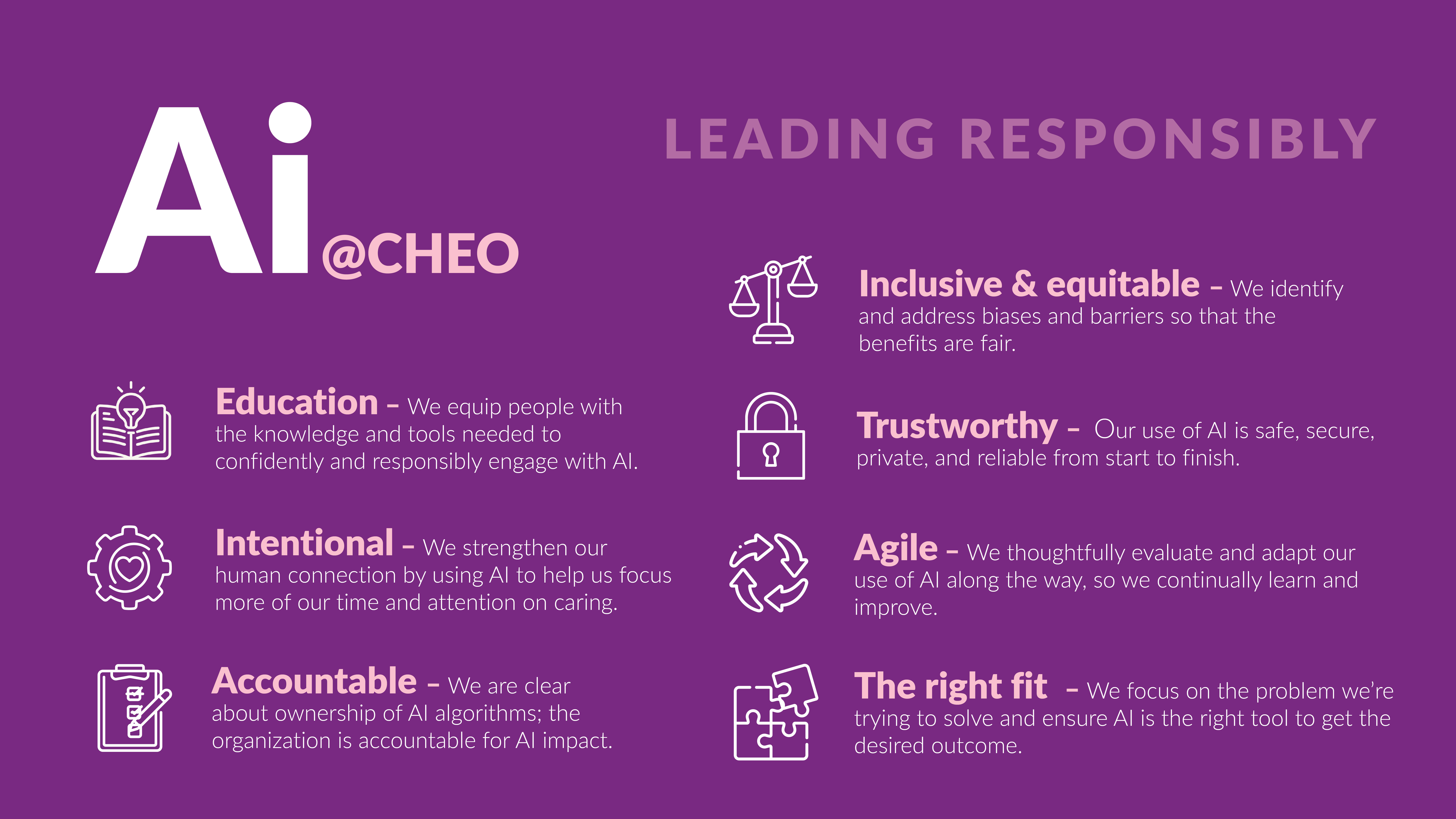
Learn about our AI framework and principles:
Education: We equip people with the knowledge and tools needed to confidently and responsibly engage with AI.
Intentional: We strengthen our human connection by using AI to help us focus more of our time and attention on caring.
Inclusive & Equitable: We identify and address biases and barriers so that the benefits are fair.
Trustworthy: Our use of AI is safe, secure, private, and reliable from start to finish.
Accountable: We are clear about ownership of AI algorithms, the organization is accountable for AI impact.
Agile: We thoughtfully evaluate and adapt our use of AI along the way, so we continually learn and improve.
The Right Fit: We focus on the problem we’re trying to solve and ensure AI is the right tool to get the desired outcome.
Research in Action
CHEO’s world-first ThinkRare algorithm is improving the lives of children, youth, and families by helping to flag some of the youngest patients who may have undiagnosed rare diseases, which answers important medical questions sooner. Read the full story.
Related News
-
20/07/2026
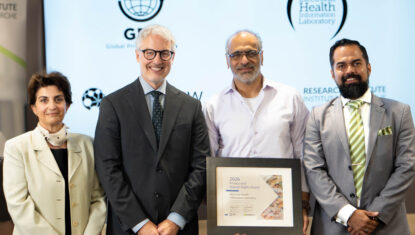
CHEO Research Institute’s Electronic Health Information Laboratory receives international privacy and human rights award
-

14/07/2026
CHEO partners with Anthropic to explore the responsible use of AI in child health
-

08/07/2026
Launching Precision Rewired: A CHEO Research Institute Limited Series Podcast on the future of child and youth mental health
Research Projects
-
Predicting child and adolescent mental health emergency department revisits: a machine-learning approach compared to a clinician-derived baseline
01/12/2025
This study aimed to develop and validate a machine‑learning–based algorithm using electronic health record data to predict child and youth mental health emergency department revisits, and to compare its performance with a clinician‑weighted model. The machine learning approach outperformed the clinician-driven baseline while identifying clinically meaningful predictors such as prior ED visits, medication history, substance use, and outpatient mental health care. These findings demonstrate that interpretable ML models can complement clinical expertise and support improved planning for CYMH emergency care.
-
Transformer-based deep learning ensemble framework predicts autism spectrum disorder using health administrative and birth registry data.
07/04/2025
Early diagnosis and access to resources, support and therapy are critical for improving long-term outcomes for children with autism spectrum disorder (ASD). ASD is typically detected using a case-finding approach based on symptoms and family history, resulting in many delayed or missed diagnoses.
-
Augmenting Insufficiently Accruing Oncology Clinical Trials Using Generative Models: Validation Study
03/03/2025
Recruiting a sufficient number of patients for clinical trials is challenging [1], and the inability to recruit participants is the cause of failure for many clinical trials [2]. Approximately, 25% of clinical trials are discontinued before completion [3], with insufficient recruitment being the most frequent reason in 31% of the cases [4]. For adult cancer trials, between 20% and 50% fail to complete or were unable to reach recruitment goals [5-9]. This has been exacerbated by the recent pandemic where many trials experienced a considerable reduction in recruitment rates [10-13], which has continued after the pandemic [12]. While poor accrual is a problem in all trials, it is a greater problem in government (ie, academic) sponsored trials [14,15]. When a study is unable to recruit a sufficient number of patients, the study can be stopped, and the relevant analyses are performed on the available data. However, not reaching accrual targets results in underpowered analyses, and the smaller sample sizes increase the risk of unstable parameter estimates.
-
Deep learning prediction of renal anomalies for prenatal ultrasound diagnosis
19/04/2024
This study emphasizes the potential of deep learning models in predicting kidney anomalies from limited prenatal ultrasound imagery. The proposed adaptations in model representation and interpretation represent a novel solution to multi-class prediction problems.
-
The transformative potential of AI in obstetrics and gynaecology
27/03/2024
This study explores the use and potential of AI in three focus areas: predictive modelling for pregnancy complications, Deep learning-based image interpretation for precise diagnoses, and large language models enabling intelligent health care assistants.
Researchers
-
Kasim Abdulaziz
Investigator, CHEO Research Institute
-
Christine Armour
Investigator
-
Kym M Boycott
Senior Scientist, CHEO Research Institute
-
Paula Cloutier
Investigator, CHEO Research Institute
-
Kevin Dick
Investigator, CHEO Research Institute
-
Khaled El Emam
Senior Scientist, CHEO Research Institute Professor, Faculty of Medicine, University of Ottawa
-
Jeff Gilchrist
Associate Scientist, CHEO Research Institute
-
Allison Kennedy
Investigator, CHEO Research Institute
-
Andrew Lapointe
Scientist, CHEO Research Institute
-
Jean Ngoie
Investigator, CHEO Research Institute
-
Kathleen Pajer
Senior Scientist, CHEO Research Institute
-
Dhenuka Radhakrishnan
Scientist, CHEO Research Institute