
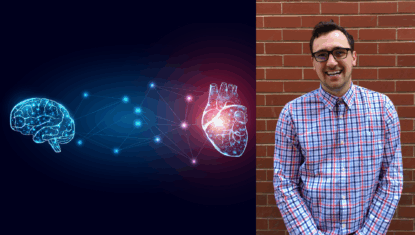
Dr. Andrew Lapointe is a digital health technology Scientist Scientist at the Children’s Hospital of Eastern Ontario (CHEO) Research Institute and an Associate Professor affiliated with the Precision Child and Youth Mental Health (PCYMH) initiative and the Brain-Heart Interconnectome (BHI).
As an early career researcher, Dr. Lapointe’s program occupies a unique niche at the intersection of neuroscience, physiology, data science and engineering. His research is dedicated to mapping “Brain-Body Dynamics,” aiming to identify objective, biologically grounded biomarkers that can transform the landscape of pediatric mental health care.
He leads the development of a multimodal neuroimaging platform that combines electroencephalography (EEG), functional near infrared spectroscopy (fNIRS), electrocardiography (ECG), and accelerometry, enabling the simultaneous assessment of brain function, physiological regulation, and real-world behavior. Using this platform, he leverages his expertise in advanced statistical modeling to identify clinically meaningful neural markers associated with mental health trajectories in children and adolescents.

Related News
Research Projects
-
A multimodal neuroimaging study of cerebrovascular regulation: protocols and insights of combining electroencephalography, functional near-infrared spectroscopy, transcranial Doppler ultrasound, and physiological parameters
09/01/2025
This study outlines the development of a simultaneous EEG‑fNIRS‑TCD neuroimaging protocol designed to capture complementary measures of neuronal activity, microvascular oxygenation, and arterial blood‑flow dynamics. Pilot testing demonstrated that the trimodal setup reliably detected expected physiological responses across diverse neurovascular tasks, while also revealing methodological considerations for larger‑scale use. The findings highlight the protocol’s potential to provide a comprehensive, motion‑tolerant assessment of cerebrovascular regulation during functional challenges.
-
Microstate analyses as an indicator of anesthesia-induced unconsciousness
06/01/2023
This study aimed to identify differences in EEG microstate topographies across three perioperative phases—pre‑induction, surgical anesthesia, and PACU recovery—in adult surgical patients. The researchers found that microstate duration increased significantly during surgery, alongside reduced occurrence and the emergence of microstate F under propofol anesthesia, with additional age‑related effects observed during recovery. These findings suggest that perioperative microstate patterns may help monitor anesthetic depth and offer insight into postoperative delirium risk.