
06/05/2026
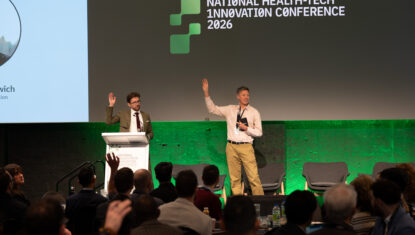
The persistent challenge of moving proven health technologies beyond pilots and into real-world adoption to improve health and health care was confronted at this year’s National Health-Tech Innovation Conference, co-hosted by the CHEO Research Institute’s Core Innovation and Velocity.
Held in Kitchener-Waterloo – the heart of Canada’s innovation district – the two‑day conference brought together nearly 200 innovators, researchers, clinicians, health‑system operators, investors, and policy leaders from across the country to co-design actionable solutions that move health innovation from ideas to impact.
“This conference wasn’t about more discussion, it was about clarity,” said Dr. Matthew Bromwich, Director of Core Innovation at the CHEO Research Institute. “The AI summaries helped us cut through opinion and capture what the room collectively knows: that Canada doesn’t have an innovation creation problem, it has a diffusion of innovation problem. And that problem is solvable.”
What set the NHTIC apart was the capturing and synthesis of the formal small group discussions that often happen in isolation at conferences and turning them into actionable insights when paired with the broader panels and keynotes.
From pilot paralysis to procurement pathways
Conference sessions focused on the systemic barriers slowing the adoption of health innovation, including pilot paralysis, procurement gridlock, capital gaps, and policy friction. Expert summaries highlighted consistent themes:
- Too many pilots stall despite strong evidence, delaying patient benefit and wasting public dollars
- Procurement and pilot processes remain disconnected and misaligned
- The cost of inaction is rarely measured, incentivizing delay over adoption
- Capital needed to move from pilot to scale falls into a fragmented “missing middle”
Participants worked through these issues together, generating actionable frameworks such as national adoption pathways, outcome‑based procurement principles, milestone‑tied funding models, and standardized decision tools to determine when a pilot is, or is not, needed.
Roughly two thirds of attendees were innovators or researchers, complemented by strong clinical and policy leadership. This rare mix supports real‑world adoption rather than theoretical solutions.
A call for leadership and Canadian momentum
Dr. Jason Berman, CEO and Scientific Director of the CHEO Research Institute emphasized that standing still now carries greater risk than moving forward.
“Health care has always been cautious and for good reason,” said Dr. Berman. “But today, the real risk is inaction. Canada is ready to lead in health innovation, and research institutes like CHEO are critical partners in turning bold ideas into real‑world impact.”
Dr. Berman also underscored the role of initiatives like Core Innovation in convening clinicians, researchers, entrepreneurs, government, and industry at the same table – accelerating commercialization, supporting Canadian health‑tech companies, and strengthening the country’s health‑care system and innovation economy.
The message is clear: Canada has the talent, evidence, and solutions. Now it must align incentives, pathways, and leadership to act.
The National Health‑Tech Innovation Conference was made possible through the support of its sponsors: Calian, Communitech, the Canadian Medical Association, EY, the Medical Innovation Xchange (MiX), and Mitacs.
Follow the work of Core Innovation at the CHEO Research Institute accelerating real‑world adoption of impactful health technologies.