
23/02/2026
Ottawa, Ontario — Monday February 23, 2026
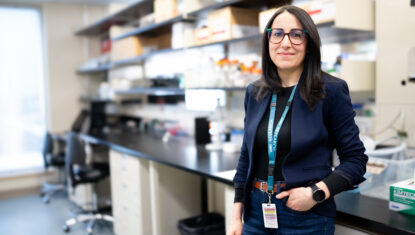
What if some of the most powerful cancer‑fighting cells in the human body are ones we haven’t fully understood, or used, yet? The research of Dr. Zakia Djaoud, Scientist at the CHEO Research Institute and Tier 2 Canada Research Chair in Virus Host Interactions, is looking to reshape the future of cancer immunotherapy by focusing on a specific immune cell: the gamma delta (γδ) T cell.
Supported recently through a Canadian Institutes of Health Research (CIHR) Fall 2025 Project Grant, Dr. Djaoud’s research zeroes in on how these unique cells develop, how they distinguish dangerous cells from healthy ones, and how their natural strengths can be engineered into more effective and widely accessible cancer treatments.
Project Title: Exploring the education of γδ T cells to foster their therapeutic potential
Funding: $944,775
A new frontier in immunotherapy
Cellular immunotherapy has revolutionized cancer treatment by harnessing the immune system to attack tumors. Yet most approaches rely on “conventional” T cells, which require donor matching and can be difficult and costly to engineer.
γδ T cells are different. They are fast‑acting, do not require matching between donors and recipients, and hold potent natural tumor‑killing abilities. Dr. Djaoud’s research points to an especially powerful source: a population of “trained” γδ T cells enriched in healthy individuals who have previously been exposed to cytomegalovirus, a common virus carried silently by most adults worldwide. These cells appear uniquely “primed” to recognize and destroy cancer cells. Her team’s discoveries suggest that these cells could be more effective than the γδ T‑cell subsets that current clinical strategies rely on.
“Our goal is to uncover immune responses that can be turned into more effective and more widely accessible cancer treatments. Our goal is to bridge the gap in knowledge about γδ T cells to develop more effective strategies for utilizing them in cancer therapies. The project grant support from the CIHR brings us closer to that possibility, and I’m excited to see where the science leads us next,” said Dr. Djaoud, Assistant Professor, Department of Biochemistry, Microbiology and Immunology at the University of Ottawa.
The project aims to decode what makes these cells so potent, map their specialized immune features, and create strategies to activate or expand them for therapeutic use. Ultimately, they aim to create treatments that are not only more efficient but also accessible to a broader range of patients, including children and youth, and reduce the burden on both patients and health care systems.
“Dr. Djaoud’s research is opening new pathways in immunotherapy, with the potential to benefit families who need better options when fighting cancer. It reflects the kind of innovative science we’re proud to pioneer and support at the CHEO Research Institute,” said Dr. Jason Berman, CEO and Scientific Director, CHEO Research Institute; Vice‑President Research, CHEO
The CHEO Research Institute is one of the top 25 research hospitals in Canada, and ranks second among Canada’s top small-tier research hospitals with record growth in research spending in 2024 according to the national Research InfoSource rankings.